Occasionally NSFW. Don't say I didn't warn you.
135 stories
·
2 followers

AI-Assisted Paper on Z-Library Cites a TorrentFreak Article That Doesn’t Exist

1 Share

robot facepalmZ-Library is one of the largest pirate ebook libraries on the Internet, offering millions of books and papers for free.

For students and researchers who can’t afford expensive textbooks and journal subscriptions, it can be a useful resource. At the same time, publishers have spent years trying to take it down, with takedown notices and blocking orders, while U.S. authorities indicted its alleged operators.

This tension is the subject of a paper published earlier this month in the journal New Review of Academic Librarianship, written by two librarians at Nigerian universities.
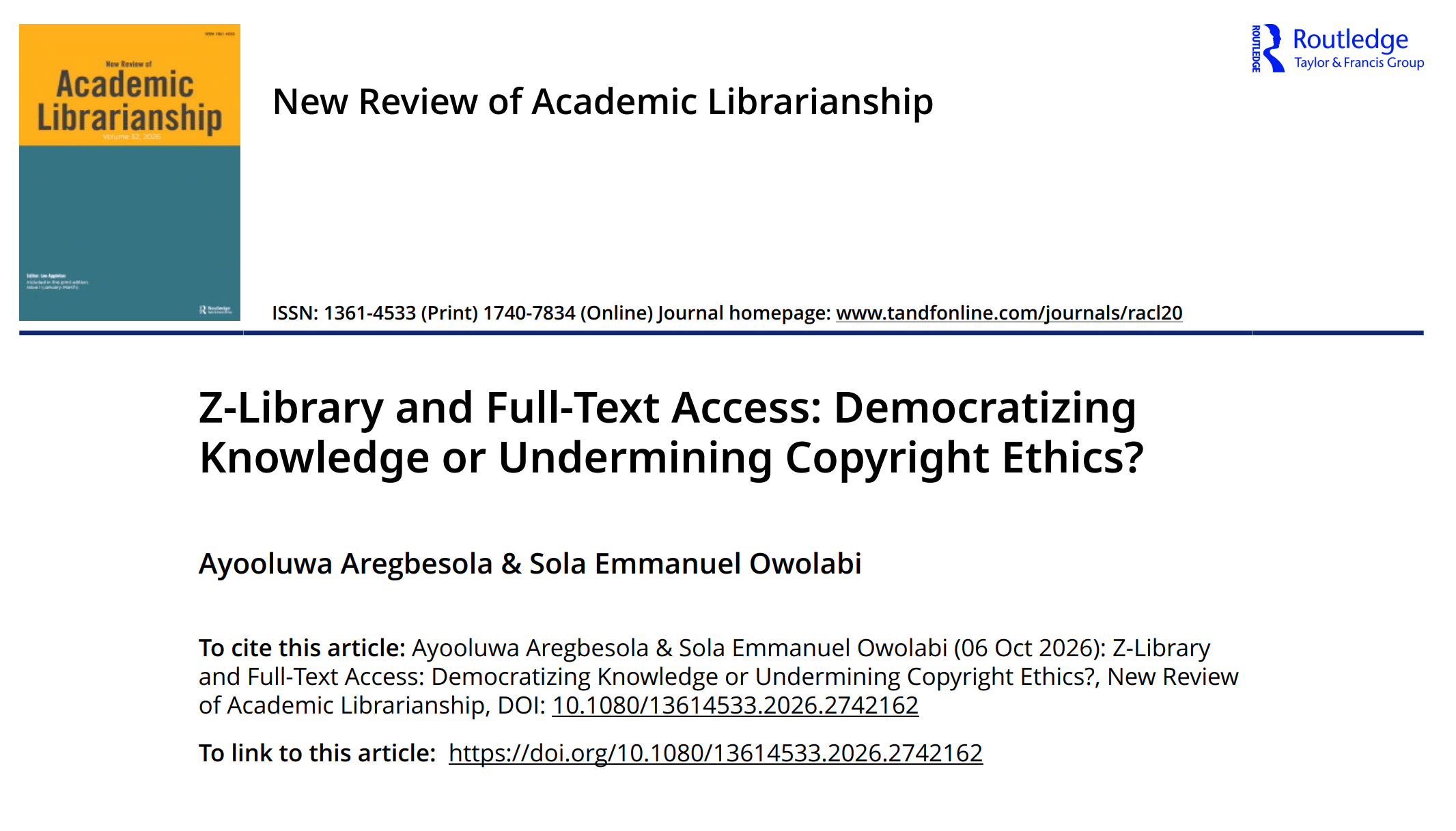
The paper

the article

The peer-reviewed academic paper doesn’t pick a side and the lead author kindly shared a copy of their work with TorrentFreak. While the conclusions are not immediately newsworthy, there was one reference that stood out right away.

A TorrentFreak Article That Doesn’t Exist

In a section on enforcement against Z-Library, the authors write that major academic publishers, including Elsevier and Springer Nature, have taken similar legal action. The reference is a 2021 TorrentFreak article, as shown below.
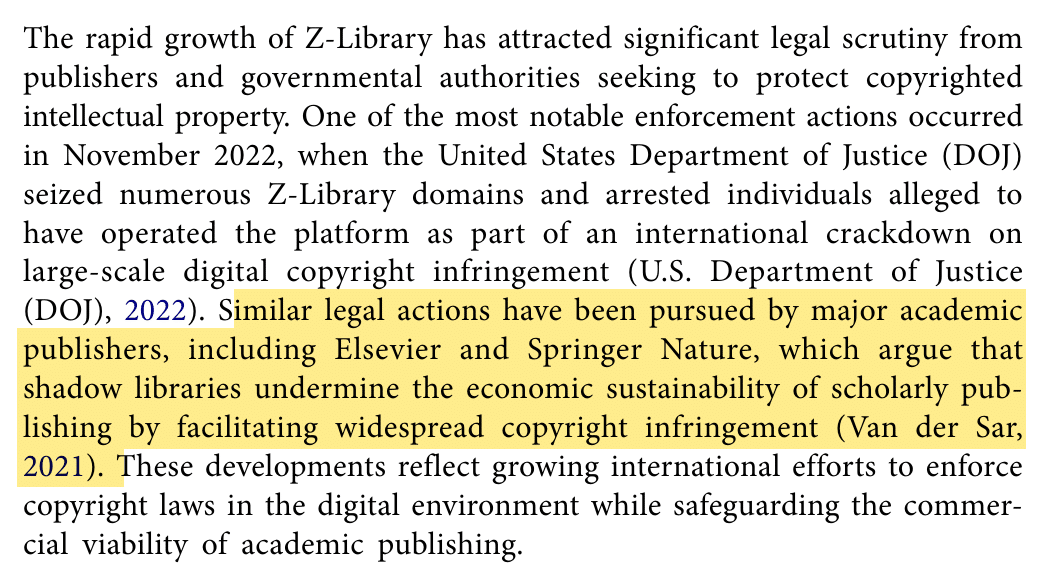
The claim

The claim

The problem is that this particular legal action is new to us. The reference section lists the article as “Publishers continue crackdown on shadow libraries” and links to the TorrentFreak homepage. However, we have never published an article with that title.

We did report that Elsevier and Springer Nature obtained a UK blocking order against Sci-Hub, and that several Z-Library domains were temporarily suspended over copyright infringement claims. However, we’re not aware of this particular legal action against Z-Library.

Looking more closely, we see more claims that don’t seem to fit. The paper’s account of the Z-Library criminal case, for example, states that the U.S. Department of Justice “arrested individuals” in 2022.
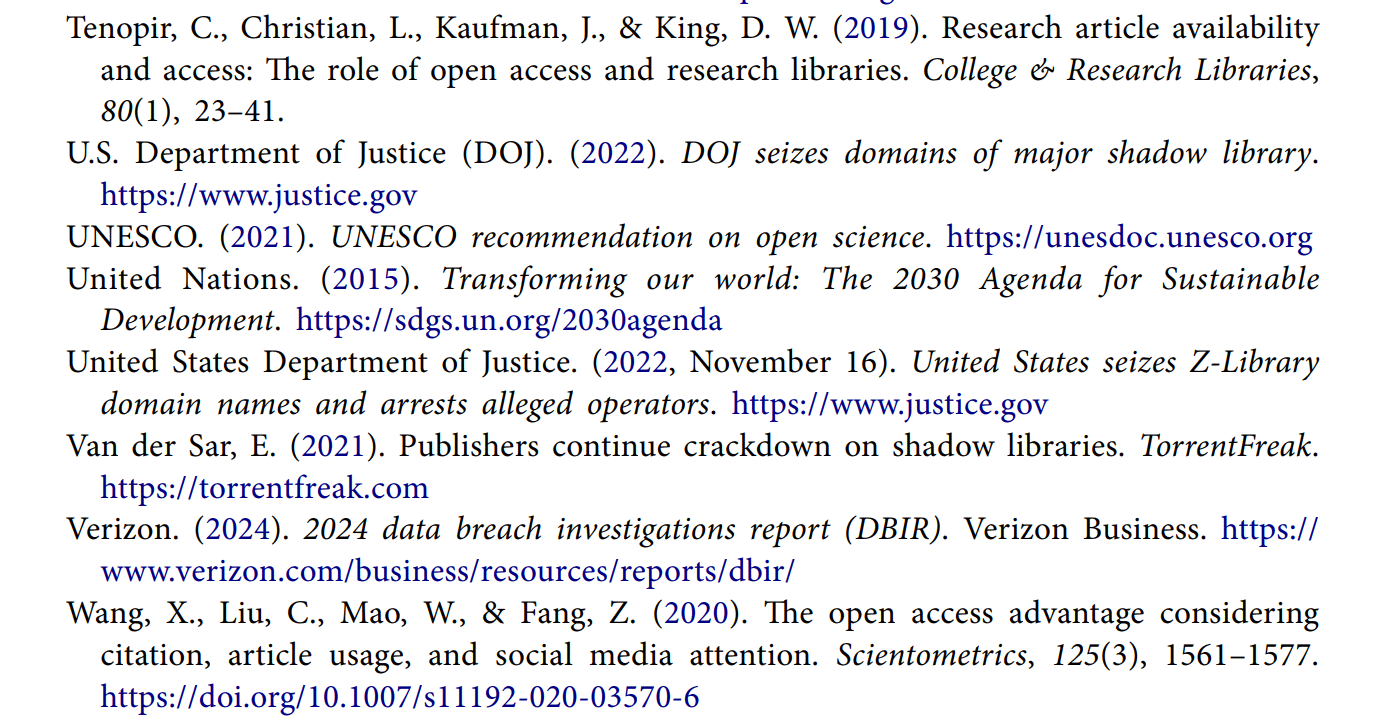
Some references

references

The DOJ’s own press release says that the two alleged operators, whose indictment we covered at the time, were arrested in Argentina “at the request of the United States.” The title the paper gives for that press release doesn’t exist either.

Plausible but Inaccurate

These non-existent citations appear plausible, as they cite real publications and organizations in a fitting context. However, that doesn’t mean they are accurate. When we went over the full reference list, we noticed that this applies to more sources.

The paper cites a 2019 Harvard Journal of Law & Technology article by IP law professor Daniel Gervais, titled “The future of intellectual property in the shadow of shadow libraries.” The table of contents of the cited issue doesn’t include it, and the cited pages are taken up by two articles on other topics.

The same applies to a 2019 College & Research Libraries article attributed to Carol Tenopir and colleagues. The cited issue has no article by Tenopir. She did co-author a 2019 article on a similar topic, but it appeared in a different journal, under a different title.

Other references that couldn’t be located include a 2019 article credited to Björn Brembs and articles credited to authors named Smith, Piper, Okike and Aronson, as well as a Kaspersky report on “the hidden dangers of shadow libraries.”

In total, we had trouble finding at least ten of the 44 references in the paper, as well as others that didn’t necessarily back the stated claims.

100% AI?

The obvious question is where these mystery references came from. The paper’s acknowledgements may offer a hint in the right direction, as they mention that AI was used in the research and writing process.

“We confirm that Consensus AI was used in sifting through large volume of literature and extract relevant information,” the authors write. They add that ChatGPT was used to improve the language of parts of the paper.
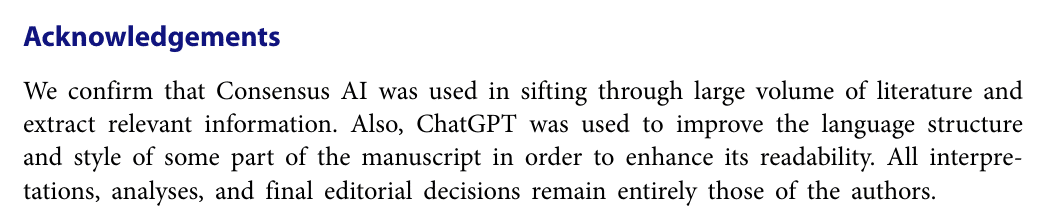
Acknowledgements

Acknowledgements

AI chatbots are known to invent references, often with plausible titles credited to real experts in the field. This could explain the findings, although it doesn’t prove that AI wrote these references.

We also ran the paper’s abstract and conclusion through the AI detection tool Pangram. For both sections, the tool reported that “100% of the text is likely AI-generated.” These types of tools are not perfect and can produce false positives, but it would fit the picture.
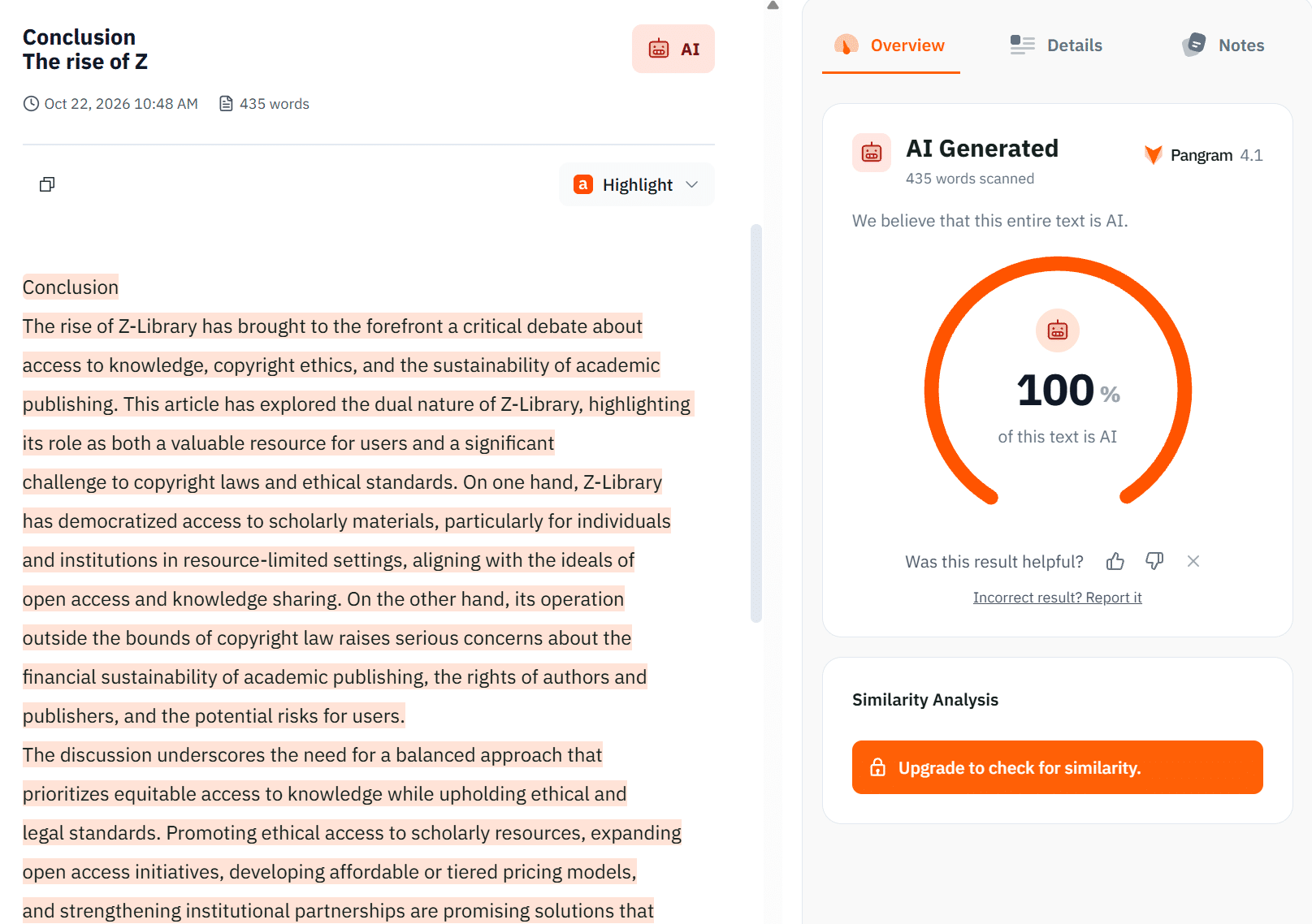
Pangram’s conclusion

pangram says 100% AI

It would be rather ironic if AI caused these errors. It would mean that a paper in a commercial, peer-reviewed journal, published by Taylor & Francis, relied on AI to write about Z-Library. Meanwhile, many rightsholders are suing AI companies for using shadow libraries to train AI models.

Interestingly, the paper explicitly warns that sites such as Z-Library hurt publishers’ revenue, which funds peer review and editing.

“The widespread use of Z-Library poses significant challenges to the sustainability of academic publishing. Publishers rely on subscription fees and paywalls to fund the peer review, editing, and distribution of scholarly works,” it reads, presumably generated by AI as well.

The paper doesn’t mention that peer reviewers generally aren’t paid for their work, an issue that was central to a recent lawsuit against major academic publishers, including Taylor & Francis.

Publisher Investigates

The lead author initially shared a copy of the paper with us, but didn’t answer our follow-up questions about the mysterious references. We also asked Gervais, Brembs and Tenopir whether they wrote the papers that are credited to them, but they didn’t respond either.

Publisher Taylor & Francis did reply and says that it’s looking into the matter.

“I can confirm that this has been referred to our Editorial and Publishing Ethics & Integrity teams, who will investigate the concerns you have raised,” a Taylor & Francis spokesperson informed TorrentFreak.

The publisher will not comment further while the investigation is ongoing. Whether the paper will be corrected or retracted has yet to be seen.

—

The paper “Z-Library and Full-Text Access: Democratizing Knowledge or Undermining Copyright Ethics?” is available here.

From: TF, for the latest news on copyright battles, piracy and more.

Read the whole story
gible
1 hour ago
reply
Australia
Share this story
Delete

The Internet goes on high alert after discovery of 8 compromised TLS certs

1 Comment and 2 Shares

Security personnel around the world are on high alert Tuesday following the discovery of eight TLS certificates with private keys so weak they could allow anyone to mint trusted browser and app credentials for any site on the Internet.

As of late morning Tuesday, browser makers and some major apps and programming languages had blocked all eight of the intermediate certificates. There are no reports of certificate transparency logs, which track the issuance of all browser-trusted certificates, showing the compromised keys being used maliciously. The threat remains far from over, however, because it will be hard and time-consuming to update other key parts of the Internet, such as Linux distributions and embedded and Internet of Things devices.

One word: bonkers

The eight intermediate certificates belong to India-based certificate authority eMudhra Limited. An informal advisory published to emudhra.we-have-a-problem.com over on Tuesday posted the message “We have a problem here - Wayne.” The words were digitally signed using the private key of one of the eMudhra certificates. With proof that the reporting party had control of the key, defenders scrambled because the same key could be used to sign unauthorized certificates that would be trusted by millions of servers worldwide.

Read full article

Comments


Read the whole story
jgbishop
4 days ago
reply
Yikes!
Raleigh, NC
gible
3 days ago
reply
Australia
Share this story
Delete

A Vat of Terrible Experiences

1 Share

Taxes are a royal pain for everyone. Amazon has found a unique way to make them even worse, as Kris W. attests:

I recently bought a €9.61 kitchen knife on Amazon Spain. My card was charged €7.94 instead. After some investigation, I discovered that Amazon had applied an old VAT registration number I'd added to my personal account years ago, and had classified my purchase as a VAT-exempt intra-EU business transaction. The invoice even contained my business address from 2022, which no longer appeared anywhere in my account settings. I just wanted to remove the VAT number so I could go back to buying kitchen utensils without accidentally generating international tax paperwork.

European VAT Taxes

Unfortunately, Amazon no longer provided any visible way to manage that VAT number. Their customer support chatbot insisted I provide the order number from which I wanted the VAT number removed. A human agent confidently explained that I must have entered it into a secondary address field, and instructed me to delete and recreate my shipping address. Another support representative sent me an extensive list of documents I'd need to provide, including my passport, airline boarding passes, proof of export outside the EU, or my NATO identification card. Apparently removing a VAT number from an Amazon account is a process normally reserved for international travelers, Andorran residents, and military alliances.

Eventually, I found Amazon's official help page. It explicitly stated that VAT numbers could be removed either by contacting Customer Service or by creating an Amazon Business account to use the self-service option. After another round of correspondence, Customer Service informed me that they were not allowed to remove VAT numbers and instructed me to use the Business settings that my personal account didn't have. So I followed the documentation and created a Business account using my existing email address. During registration, Amazon required me to enter the very VAT number I was trying to remove, then promptly congratulated me by email on successfully adding and activating it.

But I couldn't access the Business settings yet. Amazon couldn't verify my business and demanded official documentation, so I obtained two freshly-issued certificates from two separate Spanish government agencies to prove that I was, in fact, a self-employed software developer. I uploaded both documents and waited. Eventually, my shiny new Amazon Business account was approved. I now had a separate Business account, complete with its own purchasing features and complimentary Business Prime membership. At last, I could navigate to the promised VAT-management page!

The page displayed my VAT number, confirmed it was valid, and offered a button to add more tax information. Beside the existing number, however, there was no Edit button. No Delete button. No self-service removal option whatsoever. There was only a link saying, Contact Customer Service to change your tax ID.

Naturally, the link led to a generic help center. After creating an entire business account, submitting government paperwork, and successfully registering the same VAT number a second time, I had arrived precisely where I started: Customer Service, which had already explained that it was not allowed to remove VAT numbers.

[Advertisement] Picking up NuGet is easy. Getting good at it takes time. Download our guide to learn the best practice of NuGet for the Enterprise.
Read the whole story
gible
5 days ago
reply
Australia
Share this story
Delete

Busting the Myth that Plastics are Chemically Inert in Water

1 Share

One of the often made claims about plastics is that they are chemically inert under most conditions, such as when exposed to water. This long-held belief has also challenged the notion that micro- and nanoplastics (MNPs) are dangerous to organisms such as us human animals. A hitherto unknown mechanism between common plastics as investigated by [Naixin Qian] et al. and published in Nature serves to generate highly reactive hydroxyl radicals when exposed to water.

Hydroxyl radicals (HO•) are the neutral form of the hydroxide ion (OH–). It’s a free radical that tends to be extremely short-lived due to its reactivity, much like the singular oxygen molecule that is freed at the plastic-water interface. The energy provided for this reactivity comes from the electrostatic effect, itself highly correlated with many plastics, with the six types of microplastics used in the experiment showing varying levels of free radicals, particularly for the more hydrophobic types.

This high reactivity of free radicals is a well-known problem in cellular biology, with evolution having developed many tools over the years to deal with capturing these radicals as well as repair the (DNA) damage that they can cause. The effect of these microplastics and their generated free radicals was thus studied as well.

Of note here is that the electrostatic effect itself already serves to draw charged biomolecules to it, before the impact of free radicals is considered. By using mouse red blood cells and exposing them to polystyrene (PS) microplastics fatal damage was observed to the red blood cells.

This indicates that there are at least three possible ways in which MNPs can be harmful to organisms. It also provides another clue to how this may affect the ageing of plastics, among other implications.

Currently there is still ongoing debate on whether MNPs are truly harmful and just how prevalent they may be in e.g. our bodies. Reliably detecting them in e.g. biological tissues remains a challenge, which this new study may also be helpful with, since one of our biggest blind spots is that we lack solid knowledge of how MNPs may behave inside an organism.

Read the whole story
gible
7 days ago
reply
Australia
Share this story
Delete

MeFi: Overdose Offsets

1 Comment
Each bag carries a small but real chance of killing whoever buys it. Each bag also sends $1.80 to the Against Malaria Foundation, which GiveWell estimates saves a child's life for about $5,500. My customers die at a rate of roughly one per 4,000 bags. Four thousand bags at $1.80 buys nets for 1.3 children. Every death on my corner is offset, with a third of a toddler left over, and I'd like that number in the conversation the next time somebody calls me a murderer out the window of a passing Kia.
Read the whole story
gible
7 days ago
reply
IMO they should increase the donation so that the ratio is 2 children saved per customer death. Round numbers are easier to understand.
Australia
Share this story
Delete

People holding up the internet

3 Shares

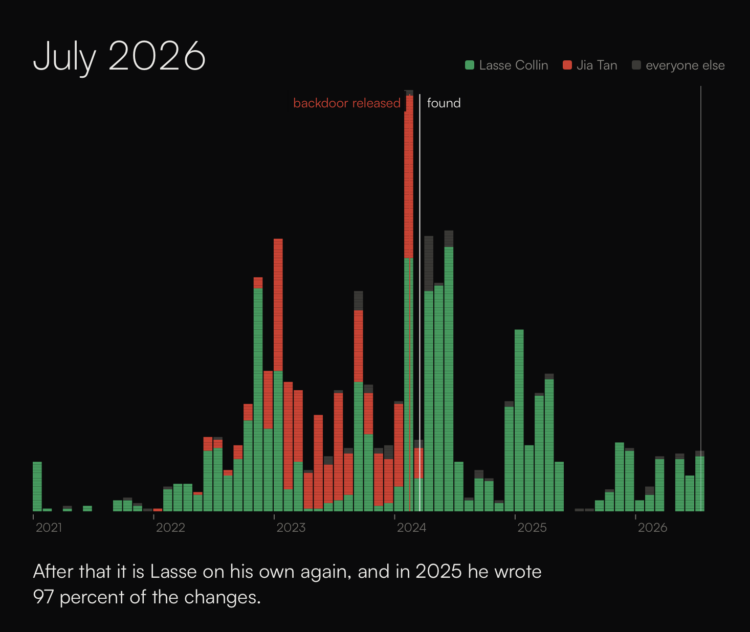
In reference to the xkcd comic that illustrates the internet as a stack of blocks propped up by a small project, sheets.works shows development history of real open source projects that our devices depend on. It is not uncommon for a single developer to maintain widely used open source software on a volunteer basis.

Tags: , ,

Read the whole story
gible
7 days ago
reply
Australia
ameel
8 days ago
reply
Melbourne, Australia
Share this story
Delete
Next Page of Stories