Log in

Hilarius Bookbinder | Scriptorium Philosophia | 1st November 2026 | U
The world is too complex for our simple minds
We need explanations because have you looked around? This place is complicated, weird, and individually we understand almost nothing. Go ahead, try to explain how anything works beyond the most superficial layer. How about something you may well be using right this moment, your cell phone. It works how, exactly? All right, maybe I’m starting off too ambitiously. Let’s try this: from scratch, how much of the modern world could you personally re-build? Could you make a fire with no matches? Dig up iron ore and make tools out of it? Know which wild plants to eat or why they are nutritious? Could you get as far as the water wheel? It probably wouldn’t be long before you viewed the sun (giver and sustainer of life) as a god. It’s not surprising to use the gods as universal explainers.
The world is daunting without some kind of explanation—if you don’t know the difference between a mole and a molecule, chemistry is frightening with a lot of unpronounceable words. Check out this scary-looking product. Mostly gasses, some carbon, and a whole boatload of chemicals in small trace amounts. Some kind of new medicine maybe? Probably a vaccine. Whatever it is, why do we even need those little bits of bromine and strontium? I thought strontium was radioactive and bromine is some kind of corrosive toxin. And wait, is that lead? And fluorine? Isn’t fluorine like stupid dangerous? Maybe this thing is a new explosive or has a military use.
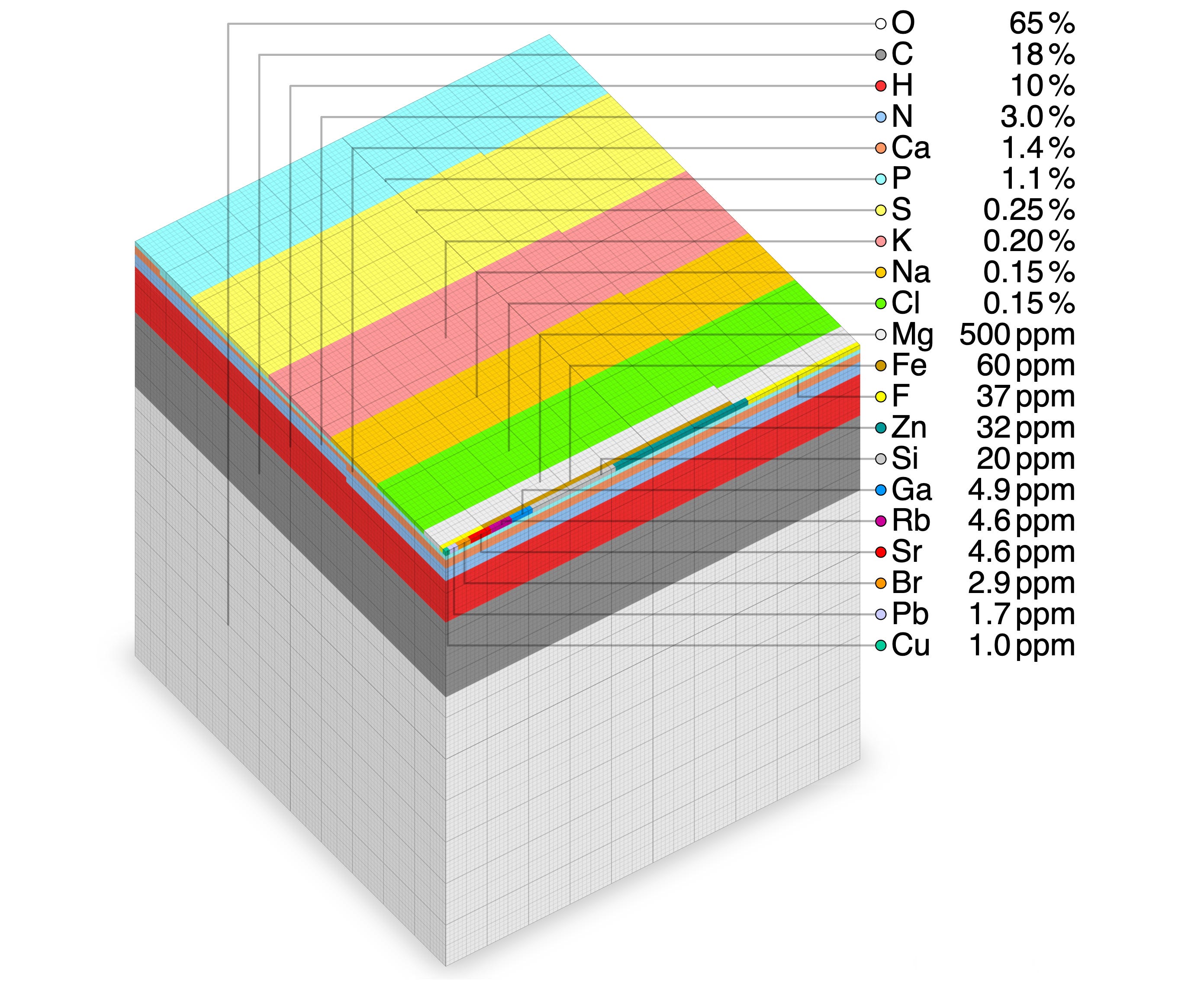
Yeah, those are the chemicals that compose a human being; that’s just you in cube form. All those components are needed or you die.
When we’re scared, ignorant, and looking for security (so, most of the time), omnicauses look appealing. Omnicauses are pseudo explanations. They are universal causes that serve a psychological need for causal understanding, but they don’t actually explain anything; they only seem to explain. But they are very, very popular. As the villain Syndrome said in The Incredibles, if everyone is super, no one is. Likewise, if everything has the same explanation, then nothing is explained.
An explanation is an omnicause when the exact same thing can be invoked as a cause for X and also a cause for not-X; it explains all and nothing. The Eagles beat the Cowboys by the grace of God one month and the next the Cowboys beat the Eagles for the same reason. When you get promoted at work it is no more than your destiny fulfilled, and when you get fired, that too is your destiny.

Tucker Carlson uses an omnicause to explain hurricanes: severe weather is sent by God to punish Americans for abortions. Greg Thomas credits God for curing his cancer because Thomas fixed up an old church. When bad things happen, it’s God. When good things happen, it’s the same explanation. Just depends on His mood.
The earliest omnicause I know about comes from Menander of Athens (342-290 BC), who wrote in his play Girl Pipers, “Tuche [luck]… destroys all logic and runs counter to our expectations, planning other outcomes. Tuche makes all efforts futile.” He is even more direct in The Changeling:
Stop reasoning; for human reason adds nothing to Tuche, whether Tuche is divine spirit or not. It’s this that steers all things and turns them upside down and puts them right, while mortal thought is just smoke and crap. Believe me; don’t criticize my words. All that we think or say or do is Tuche; we only write our signatures below.
Theophrastus, Aristotle’s successor at the Lyceum, concurs in Callisthenes: “life is ruled by Tuche, not wisdom.” Anything that happens is ascribed to the capricious whim of the goddess of luck. Tuche is the omnicause.
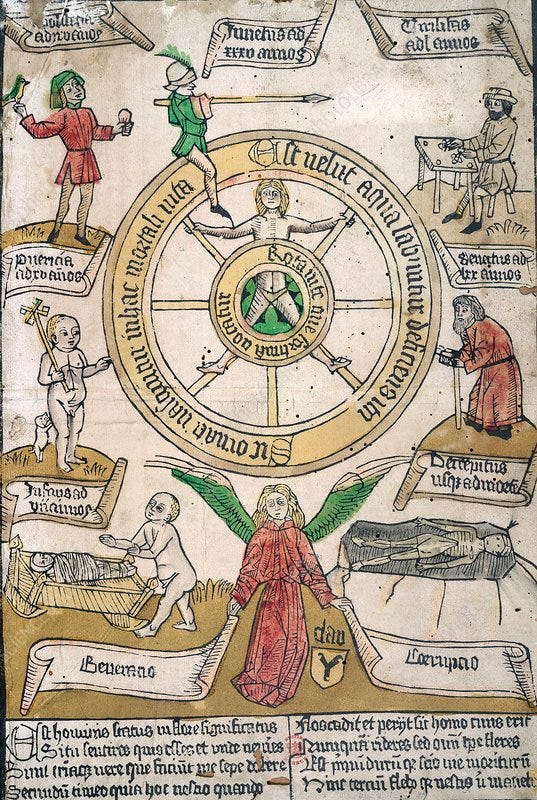
When everything is luck, we might as well stop looking for any other explanation. It is only when we are dissatisfied with omnicauses that we make headway in true understanding. The mathematicians of the Early Modern Period liked gambling;1 even Galileo worked on a gambling puzzle to appease his dice-obsessed patron the Grand Duke of Tuscany. It turned out that an endless appeal to luck wasn’t helping them win, so they developed probability theory. Here’s de Moivre: “if the Word good Luck be understood to signify a certain predominant quality, so inherent in a Man, that he must win whenever he Plays, or at least win oftener than lose, it may be denied that there is any such thing in nature.” They found a better explanation than luck.
Omnicauses don’t just show up to explain the natural world, but the human world too. Periodically someone posts something like the following, as if they are Morpheus describing the Matrix to Neo.

I’ve never understood why someone would think that the world we make isn’t real. In fact, there’s an easy proof that there is more to reality than the mind-independent world alone:
Minds exist.
Minds are not mind-independent.
Therefore something exists that is not mind-independent.
So the fact there are further mind-dependent bits of reality should not be a major shocker. How people behave and the way society is structured is mysterious and complex, so of course it’s appealing to reach for an omnicause. Here’s Karl Popper, accusing Freud and Adler of giving completely unhelpful omnicauses for human behavior:
Every conceivable case could be interpreted in the light of Adler’s theory, or equally of Freud’s. I may illustrate this by two very different examples of human behaviour: that of a man who pushes a child into the water with the intention of drowning it; and that of a man who sacrifices his life in an attempt to save the child. Each of these two cases can be explained with equal ease in Freudian and in Adlerian terms. According to Freud the first man suffered from repression (say, of some component of his Oedipus complex), while the second man had achieved sublimation. According to Adler the first man suffered from feelings of inferiority (producing perhaps the need to prove to himself that he dared to commit some crime), and so did the second man (whose need was to prove to himself that he dared to rescue the child). I could not think of any human behaviour which could not be interpreted in terms of either theory. It was precisely this fact—that they always fitted, that they were always confirmed—which in the eyes of their admirers constituted the strongest argument in favour of these theories. It began to dawn on me that this apparent strength was in fact their weakness. (Conjectures and Refutations, p. 35).
Freud and Adler aren’t as popular as they used to be, but not to worry! There’s loads of attractive contemporary omnicauses to replace them, some liked by progressives, some by MAGA, some by the religious, some by atheists. There’s nothing that unifies the attraction to omnicauses besides being human. Examples:
Neoliberalism is the ideology at the root of all our problems: Trump, the slow collapse of public health and education, resurgent child poverty, the epidemic of loneliness, the collapse of ecosystems.
The patriarchy is what’s behind falling college admissions, the climate crisis, mass shootings, and relationship communication problems. It is the cause of climate breakdown and ecological collapse, of societal disintegration, and pandemics of illness and mental un-health as well as global poverty, war and forced migrations.
Capitalism is the cause of distress, loneliness, misery, and the mental health crisis. (Many other examples, plus pushback here.)
The Jews are the real force behind the corruption of American politics and culture. They refuse to be assimilated and are incompatible with Western civilization. They are the ones who control media, finance, and government.
The woke mind virus is destroying civilization, a calamity for our cities, and responsible for the Los Angeles wildfires. Plus it is affecting military recruitment and effectiveness.
The deep state works with a cabal of pedophile elites to secretly traffic children and consume their blood, as well as working in the shadows to undermine King Donald.
Not enough omnicauses for you? Let’s not forget George Soros, colonialism, toxic masculinity, Boomers, smartphones, racism, tribalism, childhood trauma, the elites, globalists, the position of the stars and planets at birth, and Satan. You never know what the universe has in store for you.
Back in pre-industrial days when most people were farmers living in small communities with common values, understanding the social order was a much easier proposition. The modern social world—like iPhones— is so complex that no one person can fully grasp how it works; thus we’re attracted to a simplifying omnicause. Apart from just being bad explanations, omnicause thinking is a risk because people tend to dismiss things as useless when they don’t understand them.
For example, here’s a recent editorial in my local newspaper:
It was more than a little surprising to learn recently the Commonwealth of Pennsylvania has 6,000 job openings. This little-known factoid slipped into the news when Gov. Josh Shapiro said he wants to fill those openings with federal workers who are being furloughed by the Trump administration. Makes sense. But it's hard not to wonder: Are all those state jobs really necessary? Before filling them, lawmakers should initiate an audit of the state's payroll by an entity similar to Elon Musk's DOGE…
Sure, why do we need all those jobs? Greed is the omnicause for everything—the love of money is the root of all evil—so let’s fire those (presumably) useless and greedy workers. Since I personally have absolutely no idea what those jobs are, what role they play in society, how they serve Pennsylvanians, or any of that, I’ll assume those employees are just sitting around playing Candy Crush and suckling the taxpayer teat. Good riddance.
It’s like looking out of an airplane: all those little people running around like tiny ants, what could they possibly be doing that’s so important? Or as Camus writes, “a man is talking on the telephone behind a glass partition; you cannot hear him, but you see his incomprehensible dumb show: you wonder why he is alive.” (An Absurd Reasoning p. 11). You know what, Camus? That’s not a perspective sub specie aeternitatis, it is a perspective sub specie ignorantiae. It’s often a mystery why people do what they do, or why things are the way they are. We need to either make our peace with that or engage in some serious investigation into causes. What we shouldn’t do is triumphantly declare an omnicause and pretend that we’ve gained understanding.
E.g. Gerolamo Cardano, Blaise Pascal, Pierre Rémond de Montmort, Abraham de Moivre.